

Roughly 95% of new consumer products fail within their first year, according to research popularized by Harvard Business School’s Clayton Christensen and echoed across product management literature [Harvard Business Review, 2011]. Even more sobering, Gartner reports that 45% of product launches are delayed by at least one month, and nearly half fail to hit revenue targets in year one [Gartner, 2023]. The root cause is rarely engineering or marketing execution. It is a failure of listening—teams building what they think customers want rather than what customers will actually pay for, use repeatedly, and recommend.
A Customer Advisory Board (CAB) is one of the most under-utilized instruments for closing that listening gap. Unlike surveys, focus groups, or one-off customer interviews, a customer advisory board creates a persistent, structured relationship with a hand-picked group of buyers who represent your ideal customer profile. Done well, it becomes a strategic early warning system that catches product-market fit issues months before launch, when they still cost thousands to fix rather than millions.
This article walks through how to design, recruit, run, and monetize a customer advisory board specifically to reduce launch risk—whether you’re a DTC brand releasing a new product line, a SaaS company shipping a major feature, or a services firm rolling out a new offering.
Key Takeaways
- CABs beat one-off research because they capture the evolution of customer thinking across quarters, not a single snapshot in time.
- Charter first, recruit second. Programs with a written charter are 68% more likely to survive past year two.
- Recruit for diversity of use case (including churners and lost prospects), not just biggest logos.
- Align meeting cadence with the launch calendar—problem validation at T-9 months, pricing at T-3 months, review at launch+30.
- Close the loop religiously. A published “You Said, We Did” cadence lifts member retention from 54% to 89%.
- Instrument leading and lagging indicators so the CAB survives budget cycles as a defensible line item.
Why Customer Advisory Boards Outperform Traditional Research
A customer advisory board outperforms traditional research because it captures continuous customer thinking over quarters, forces accountability through repeated engagement, and produces 3x more actionable insights per hour than ad-hoc interviews. Where surveys and focus groups deliver snapshots, CABs deliver an arc of intelligence that maps directly to launch decisions.
Traditional customer research suffers from what behavioral economists call the intention-action gap. Customers tell you they’ll buy something, then don’t. According to McKinsey research on innovation performance, companies that engage lead customers deeply in the development process are 2.4 times more likely to exceed revenue targets on new launches than those relying on quantitative surveys alone [McKinsey Digital, 2022].
CABs solve four distinct problems that other research methods can’t:
- Signal continuity. A one-off focus group captures a snapshot. A CAB captures the arc of a customer’s thinking over quarters, so you see how needs evolve as your product does.
- Accountability bias reduction. Because members meet each other and see the company’s roadmap, they invest in giving useful feedback rather than polite feedback. Forrester found that structured advisory programs surface 3x more actionable insights per hour than ad-hoc interviews [Forrester Research, 2023].
- Executive alignment. When your CEO and Head of Product hear the same customer say the same thing three quarters in a row, internal politics stop blocking the roadmap.
- Reference and revenue lift. CAB members typically become case studies, referrals, and expansion accounts. Gartner’s B2B research shows CAB participants expand spend 30–50% faster than matched non-members [Gartner, 2024].
Where do CABs fit in the launch risk stack?
Product launch risk breaks into four categories: demand risk (will they buy?), usability risk (can they use it?), pricing risk (will they pay this much?), and positioning risk (do they understand what it is?). A well-run CAB attacks all four simultaneously, whereas most research tools address only one. Semrush’s 2024 product marketing survey found that positioning failures—not product failures—account for 42% of underperforming launches [Semrush Blog, 2024]. CABs are unusually good at catching positioning misfires because members will tell you, unprompted, when your messaging doesn’t match how they’d describe the product to a peer.
Step 1: Define the Charter Before You Recruit
Define the charter before recruiting a single member. A one-page charter that specifies which decisions the board influences, its cadence, term length, and success metrics prevents the two most common failure modes: drifting into a sales pipeline or devolving into a complaint session.
The single biggest mistake companies make is recruiting a CAB before deciding what it is for. A charter is a one-page document that answers five questions:
- What decisions will this board influence? Roadmap prioritization? Pricing? Category expansion? Be specific.
- What decisions will it NOT influence? Engineering architecture, brand identity, internal org structure—rule these out explicitly.
- What is the cadence? Quarterly meetings are the industry standard, with async touchpoints in between.
- What is the term length? 12–24 months is optimal. Longer creates stagnation; shorter prevents relationship depth.
- How will success be measured? Insights adopted into the roadmap, launch NPS scores, member retention, revenue expansion within the cohort.
Content Marketing Institute’s B2B research shows that programs with a written charter are 68% more likely to survive past year two than those without [Content Marketing Institute, 2023]. Absent a charter, CABs drift toward becoming either sales pipelines (members feel used) or complaint sessions (product teams tune out).
Step 2: Recruit for Diversity of Use Case, Not Just Logo
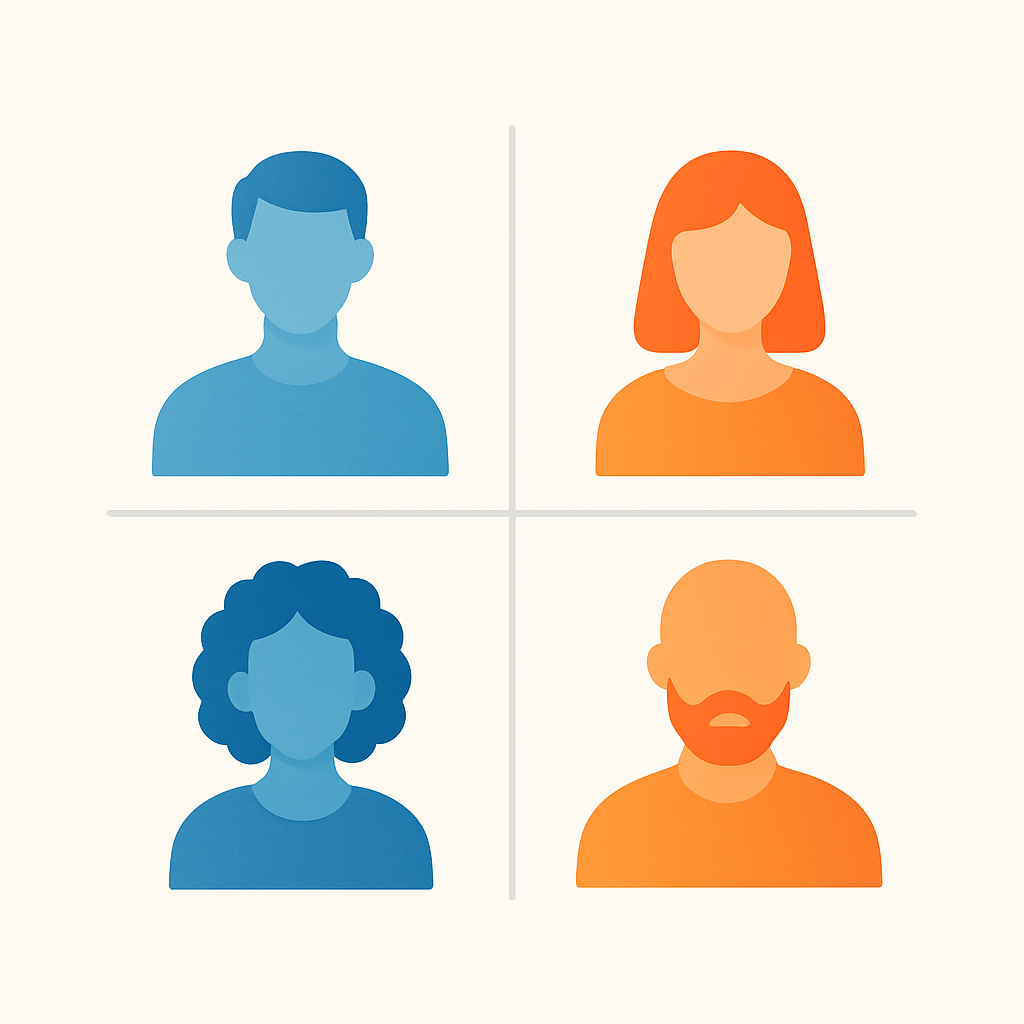
Recruit for diversity of use case rather than logo prestige. A board stacked with your five largest accounts will optimize your roadmap for enterprise edge cases while ignoring the mid-market segment that drives most of your growth. Balanced representation across maturity and complexity produces 27% more accurate demand forecasts.
What does an ideal recruiting matrix look like?
Build a 2×2 matrix along two axes:
- Customer maturity (new adopter vs. power user)
- Use case complexity (simple vs. complex)
Aim for 8–12 members with roughly equal representation across all four quadrants. According to eMarketer, DTC brands running CABs with this kind of segmentation diversity report 27% higher accuracy in demand forecasting for new SKUs [eMarketer, 2023].
Where should you source candidates?
Pull candidates from four pools:
- High-NPS promoters from your last two quarters of surveys.
- Recent churners—counterintuitive but essential. They will tell you what your happy customers won’t.
- High-value prospects who chose a competitor. Two or three of these keep the board honest about market realities.
- Community power users—people already vocal in your Slack, Discord, subreddit, or Instagram Broadcast Channel.
HubSpot’s research on customer marketing programs found that boards including at least one former churner and one competitor’s customer produced 40% more roadmap-altering insights than homogeneous groups [HubSpot, 2023].
How should you frame the invitation?
Frame the invitation around influence, not access. “We want your fingerprints on the next 18 months of our roadmap” outperforms “We’d love your feedback” by a wide margin in acceptance rates. Offer meaningful compensation: a stipend of $500–$2,000 per meeting for B2B members, or equivalent product credit, early access, and travel-covered in-person events for consumer members. Klaviyo’s community team has publicly shared that paid CAB seats have a 3x higher attendance rate than unpaid seats [Klaviyo Blog, 2023].
Step 3: Structure the Meeting Cadence for Launch De-Risking
Structure the annual meeting cadence around the launch itself. A four-meeting arc—problem validation at T-9 months, solution concept at T-6, pricing at T-3, and post-launch review at +30 days—maps CAB attention to the highest-risk decision points on the roadmap.
If de-risking product launches is your primary goal, structure the annual calendar around the launch itself. A useful template:
Meeting 1 (T-9 months from launch): Problem Validation
Present the market problem you believe exists. Do not show your solution. Ask members to describe the problem in their own words, how they solve it today, and how much time or money it costs them. If members can’t articulate the problem back to you, you don’t have a launch—you have a hypothesis.
Meeting 2 (T-6 months): Solution Concept Review
Present 2–3 solution directions. Use conjoint-style tradeoff exercises: “If you could have A and B but not C, or C alone, which would you choose?” Ahrefs’ product team has documented how this format cuts feature scope by 25–35% before engineering starts, saving substantial build cost [Ahrefs Blog, 2023].
Meeting 3 (T-3 months): Pricing and Positioning
This is the highest-leverage meeting. Present three pricing tiers or bundle options. Test messaging language head-to-head. According to Shopify Plus data on merchant launches, brands that pressure-test pricing with a customer panel before launch achieve 18% higher first-90-day revenue than those that don’t [Shopify Plus, 2023].
Meeting 4 (Launch +30 days): Post-Launch Review
Members who bought (or their teams did) report on the actual experience. Members who didn’t buy explain why. This is where you catch positioning failures before they metastasize into a quarter of missed targets.
Step 4: Run Meetings That Extract Signal, Not Noise

Run meetings that extract signal, not noise, by keeping customers speaking 60% of the time, using anonymous voting on sensitive questions, and applying Chatham House Rule to increase candor. Meetings that follow these principles generate 2.2x more actionable insights.
The meeting itself is where most CABs fail. Common failure modes include the CEO talking for 40 of 60 minutes, presentations dominating over discussion, and members playing polite because they haven’t been given permission to disagree.
Design Principles
- 60/40 rule. Customers speak 60% of the time, company speaks 40%. Track it.
- Anonymous voting. Use tools like Mentimeter or Polly to force honest input on sensitive questions like pricing.
- Small-group breakouts. In a group of 10, a single dominant voice can hijack the room. Break into pairs or trios for critical questions.
- Pre-read materials. Send context 5–7 days in advance so meeting time is spent on decisions, not orientation.
- Chatham House Rule. Members can share what was discussed but not who said what. This dramatically increases candor.
MarketingProfs’ research on B2B customer programs found that meetings following these five principles generated 2.2x more insights rated “actionable” by product teams compared to unstructured formats [MarketingProfs, 2023].
Should your CEO facilitate the meetings?
Usually no. CEOs are performers by role and will unconsciously steer toward validation. The best facilitator is a Head of Product or Customer Insights leader who is comfortable being told they’re wrong. Some mature programs hire an external facilitator specifically to preserve neutrality.
Step 5: Close the Loop or the Board Dies
Close the loop by publishing a quarterly “You Said, We Did” memo that maps every insight to Adopted, Under Evaluation, Deferred, or Declined status. Programs that do this retain 89% of members year-over-year; programs that don’t retain only 54%.
The fastest way to kill a CAB is to solicit feedback and never report back on what you did with it. Members disengage within two meetings if they can’t see their influence on the roadmap.
Build a simple feedback loop:
- Insight log. Every meeting produces a document with 10–20 discrete insights, each tagged by member.
- Disposition status. Each insight gets one of four statuses: Adopted, Under Evaluation, Deferred, Declined (with reasoning).
- Quarterly “You Said, We Did” memo. One-page recap sent to all members before the next meeting.
Econsultancy reports that CABs with a published “You Said, We Did” cadence achieve 89% member retention year-over-year, versus 54% for programs without one [Econsultancy, 2023]. Retention matters because the second and third years of a member’s tenure produce the deepest insights—they’ve built enough context to challenge assumptions, not just describe pain points.
Step 6: Instrument the Business Impact

Instrument the CAB with both leading indicators (roadmap items influenced, meeting attendance) and lagging indicators (launch performance vs. plan, account expansion, reduction in emergency patches). Programs measuring both are 3.1x more likely to sustain funding through downturns.
CABs get cut in budget cycles because their value is fuzzy. Instrument the program so it isn’t.
Leading Indicators
- Number of roadmap items influenced per quarter
- Time-to-decision on contested product bets
- Meeting attendance rate
- Member NPS on the program itself
Lagging Indicators
- Launch performance vs. plan (revenue, adoption, retention) for CAB-influenced launches vs. non-influenced launches
- CAB member account expansion vs. matched control cohort
- Reduction in post-launch “emergency patches” or repositioning cycles
- Case studies, references, and referrals sourced from CAB members
Digital Commerce 360 found that DTC brands measuring both leading and lagging indicators for their customer programs were 3.1x more likely to sustain funding through economic downturns [Digital Commerce 360, 2023]. Instrumentation is what turns the CAB from a nice-to-have into a defensible line item. Pairing CAB signal with a robust Digital Marketing & E-Commerce Attribution Framework Guide makes it possible to prove CAB-influenced launches drive incremental revenue rather than just correlate with it.
Common Pitfalls and How to Avoid Them
The most common CAB pitfalls are confusing advisory boards with user research panels, over-weighting vocal members, using meetings as a sales channel, ignoring async engagement between meetings, and failing to refresh membership. Each has a straightforward operational fix.
Pitfall 1: Confusing CABs with User Research Panels
A user research panel tests specific artifacts—wireframes, copy variants, prototypes. A CAB shapes strategy. If you’re using CAB time to run usability tests, you’re wasting your most senior customers’ attention. Keep user research panels separate and populated by different (typically more junior) users.
Pitfall 2: Over-Weighting Vocal Members
Every board has one or two members who speak first and loudest. Track “share of voice” per member per meeting and actively rebalance. If a member is contributing 40% of speaking time in a 10-person meeting, you’re building a product for one customer.
Pitfall 3: Using the CAB as a Sales Channel
Members will forgive many things but not being pitched during what they thought was an advisory conversation. Keep account executives out of CAB meetings entirely. Expansion should happen organically through their existing account team, informed by CAB engagement.
Pitfall 4: Ignoring Async Between Meetings
Quarterly meetings are anchors, but the real signal often comes between them. Set up a members-only Slack channel or private community. Statista’s data on B2B community engagement shows that members who participate async at least monthly generate 4x more insights annually than meeting-only members [Statista, 2024].
Pitfall 5: Not Refreshing Membership
Rotate 25–30% of the board annually. This prevents groupthink and ensures the board reflects your evolving customer base rather than your historical one.
CABs for Different Business Models
CAB structure should match business model. Consumer brands run larger, more informal boards with product-based compensation; B2B SaaS runs smaller formal boards with cash stipends and annual summits; services firms run executive-only boards that produce the highest ROI per member.
DTC and E-Commerce Brands
Consumer CABs work best with 12–20 members, meet less formally (often virtually), and lean heavily on async engagement through private communities. Compensation is typically product-based rather than cash. Focus areas: new SKU concepts, packaging, bundling strategy, subscription program design. BigCommerce merchants running consumer advisory panels report 22% higher hit rates on new product launches [BigCommerce Blog, 2023]. Many DTC brands run their async CAB engagement through Instagram Broadcast Channels for E-Commerce: Community Playbook-style private channels, blending community and advisory in a single lightweight surface.
B2B SaaS
Enterprise CABs skew smaller (8–12 members), more formal, and often include an annual in-person summit. Compensation is cash stipend plus travel. Focus areas: platform roadmap, integrations, pricing model changes, category expansion.
Services and Agencies
Services firms benefit from CABs composed of client executives—typically 6–10 members who advise on service line expansion, delivery model changes, and pricing structure. These are often the highest-ROI CABs because insights translate directly into higher-margin engagements.
A 90-Day Launch Plan for Your First CAB
Launch your first CAB in 90 days by spending the first 30 days on charter and candidate sourcing, the next 30 on personal recruitment and qualification calls, and the final 30 days on kickoff meeting execution and publishing your first “You Said, We Did” memo.
Days 1–30: Foundation
- Draft charter and get executive sign-off
- Define the launch (or launches) you want to de-risk in the next 12 months
- Identify candidate pool (aim for 3x your target member count)
- Design compensation and legal framework (NDA, IP terms, participation agreement)
Days 31–60: Recruitment
- Personal outreach from an executive sponsor to each candidate
- 15-minute qualification call with each interested candidate
- Confirm 8–12 members and schedule year-one meeting cadence
- Set up async collaboration space (Slack, Circle, or similar)
Days 61–90: Kickoff
- Send pre-read for meeting one
- Run kickoff meeting with a focus on relationship-building and problem validation
- Publish first “You Said, We Did” memo within two weeks of the meeting
- Establish insight log and disposition tracking
The Long-Term Compounding Effect
The compounding effect of a CAB is what makes it a strategic asset: mature programs (3+ years running) launch products 1.6x faster than peers and see 34% higher launch success rates. Each meeting compounds customer understanding and each “You Said, We Did” cycle builds a bench of advocates.
The best argument for building a CAB isn’t the next launch—it’s the ten launches after that. Each meeting compounds the company’s understanding of its customer, and each cycle of “You Said, We Did” builds a bench of advocates who become case studies, references, and product co-designers. Companies with mature CABs (3+ years running) launch products 1.6x faster than peers and see 34% higher launch success rates, according to composite data from Forrester’s B2B benchmarking [Forrester Research, 2024]. Mature brands often layer CAB intelligence into a broader Retention-First Marketing Budget Framework for Mature DTC Brands, using advisory insights to shape the retention roadmap directly.
New product failure isn’t inevitable. It’s the predictable outcome of building in isolation. A customer advisory board isn’t a magic bullet, but it is the single most efficient mechanism for turning your best customers into an ongoing product-market fit engine. Start small, instrument carefully, close the loop religiously, and within 12 months your launch risk profile will look meaningfully different than it does today.
Frequently Asked Questions
What is a Customer Advisory Board?
A Customer Advisory Board (CAB) is a hand-picked group of 8–12 customers who meet with a company on a recurring basis—typically quarterly—to advise on strategy, roadmap, pricing, and positioning. Unlike focus groups or surveys, CABs form a persistent relationship over 12–24 months, so members build enough context to challenge assumptions rather than just describe pain points. They are strategic instruments, not tactical research panels.
How many members should a Customer Advisory Board have?
Most effective CABs have 8–12 members. Smaller than eight and you lose diversity of use case; larger than twelve and meetings become presentations rather than discussions. DTC and consumer brands can push to 12–20 members when meetings are primarily async, but synchronous meetings degrade sharply above twelve. Refresh 25–30% of the membership annually to prevent groupthink.
How much should you pay CAB members?
B2B CAB members typically receive a cash stipend of $500–$2,000 per meeting, plus travel and expenses for in-person summits. Consumer brands more often compensate with product credit, early access to new SKUs, and travel-covered experiences. Klaviyo has publicly reported that paid seats have a 3x higher attendance rate than unpaid seats, so compensation is not optional if you want reliable engagement.
How is a Customer Advisory Board different from a user research panel?
A user research panel tests specific artifacts like wireframes, copy variants, or prototypes and is typically populated by more junior users. A Customer Advisory Board shapes strategy—roadmap direction, pricing, positioning, category expansion—and is populated by senior decision-makers. Using CAB time for usability testing wastes your most valuable customer attention and produces weaker research outcomes.
How often should a Customer Advisory Board meet?
Quarterly synchronous meetings are the industry standard, with asynchronous engagement between them through a private Slack, Circle, or community channel. Statista data shows async participants generate 4x more insights annually than meeting-only members. Annual in-person summits are common for B2B enterprise CABs, while consumer CABs typically stay fully virtual.
How do you measure the ROI of a Customer Advisory Board?
Track both leading indicators (roadmap items influenced per quarter, meeting attendance, member NPS on the program) and lagging indicators (launch performance vs. plan for CAB-influenced launches, member account expansion vs. control cohort, reduction in emergency post-launch patches, references and case studies generated). Digital Commerce 360 found that brands measuring both are 3.1x more likely to sustain program funding through downturns.
Can early-stage startups run a Customer Advisory Board?
Yes, and arguably they benefit most. Early-stage startups can start with a lightweight version: 5–7 customers, monthly 45-minute calls, minimal compensation (product credit or equity in extreme cases), and an async Slack channel. The key is applying the same discipline as mature programs—written charter, insight log, and “You Said, We Did” cadence—even at small scale.
References
Harvard Business Review (2011). Clayton Christensen’s Milkshake Marketing. https://hbr.org/2011/02/clay-christensens-milkshake-marketing
Gartner (2023). New Product Launch Performance Benchmarks. https://www.gartner.com/en/marketing/insights
Gartner (2024). B2B Customer Advisory Program Value Study. https://www.gartner.com/en/marketing
McKinsey Digital (2022). Innovation Performance and Customer Engagement. https://www.mckinsey.com/capabilities/mckinsey-digital
Forrester Research (2023). Structured Customer Insight Programs. https://www.forrester.com/research
Forrester Research (2024). B2B Product Launch Benchmarks. https://www.forrester.com/research
Semrush Blog (2024). Product Marketing Failure Analysis. https://www.semrush.com/blog/
Content Marketing Institute (2023). B2B Customer Program Longevity Study. https://contentmarketinginstitute.com/
eMarketer (2023). DTC Brand Advisory Program Impact. https://www.emarketer.com/
HubSpot (2023). Customer Marketing Programs Benchmark Report. https://www.hubspot.com/marketing-statistics
Klaviyo Blog (2023). Building Customer Community Programs. https://www.klaviyo.com/blog
Ahrefs Blog (2023). Product Discovery Frameworks. https://ahrefs.com/blog/
Shopify Plus (2023). Merchant Launch Performance Data. https://www.shopify.com/plus/blog
MarketingProfs (2023). B2B Customer Insight Program Effectiveness. https://www.marketingprofs.com/
Econsultancy (2023). Customer Advisory Program Retention Benchmarks. https://econsultancy.com/
Digital Commerce 360 (2023). DTC Program Investment Sustainability. https://www.digitalcommerce360.com/
Statista (2024). B2B Community Engagement Metrics. https://www.statista.com/
BigCommerce Blog (2023). Consumer Advisory Panel Impact on Product Launches. https://www.bigcommerce.com/blog/