
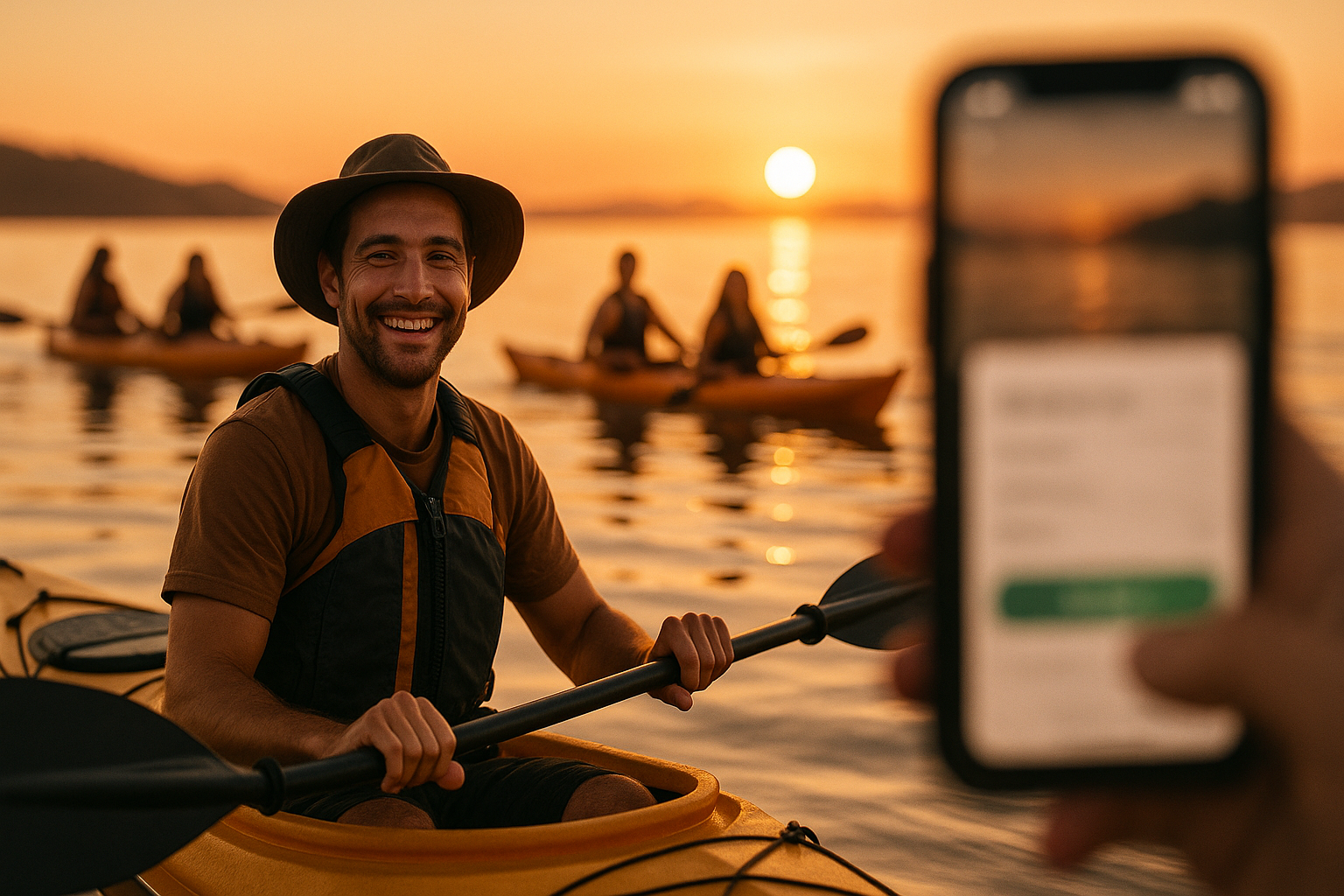
For decades, tour operators, activity providers, and experience curators have handed over 15–30% of every booking to online travel agencies (OTAs) like Viator, GetYourGuide, and Booking.com. That commission structure made sense when discoverability was hard and payment infrastructure was expensive. In 2025, it no longer does. By combining Google Ads and Shopify, tourism operators can now sell experiences directly to travelers at a fraction of the OTA cost—while owning the customer relationship, capturing first-party data, and building a durable direct-sales channel.
The travel and tourism industry is projected to generate over $1.06 trillion in online revenue globally by 2025, with online travel bookings accounting for roughly 70% of the total travel market [Statista, 2024]. Meanwhile, Google still captures the majority of travel-related search intent, with travel queries growing steadily year over year [Google Marketing Platform, 2024]. The opportunity for operators willing to build a direct channel has never been larger.
This article is a practical playbook for combining Google Ads and Shopify into a profitable direct-sales engine for experiences—covering store setup, campaign structure, landing pages, measurement, and the pitfalls that trip up most operators.
Key Takeaways
- OTA commissions of 20–30% are optional—Shopify plus Google Ads lets operators net more per booking while owning guest data.
- Shopify supports experiences via booking apps like Sesami, Experiences by Zoku, and BookThatApp, turning tours into time-slotted “products.”
- A four-campaign Google Ads structure (Branded, Non-Branded, Performance Max, Remarketing) is optimal for tour operators.
- Landing page speed and mobile UX drive conversion: 53% of mobile users abandon pages that load slower than 3 seconds.
- Measurement matters: GA4 + enhanced conversions + server-side tracking recover 5–15% of lost signal.
- A 90-day rollout can move an operator from OTA-dependent to a 50/50 direct/OTA mix within 12 months.
Why Direct Sales Matter More Than Ever for Tourism Operators
Direct sales matter because OTA commissions of 20–30% erode margin, block first-party data, and prevent operators from building lifetime value. Selling direct via Shopify recaptures margin, unlocks guest data, and enables repeat and referral revenue that compounds year over year.
OTAs excel at aggregation, but they extract a heavy price. Viator and GetYourGuide typically charge 20–30% commissions, and their algorithms deprioritize operators who refuse to discount [Digital Commerce 360, 2023]. Beyond commission, operators lose access to guest data—email addresses, purchase history, preferences—which cripples remarketing and lifetime value strategies.
Compare that to direct sales, where the operator captures margin, owns first-party data, and can build repeat and referral revenue. Research from McKinsey shows that companies leveraging first-party customer data outperform peers on revenue growth by up to 85% [McKinsey Digital, 2023]. For tourism, where 34% of travelers report returning to a previously enjoyed experience or destination [eMarketer, 2024], owning the guest relationship is a durable competitive advantage.
What is the true cost of a 25% OTA commission?
Consider an operator selling a $150 half-day kayak tour. On an OTA at 25% commission, they net $112.50. If that same booking comes through a Shopify store with a Google Ads customer acquisition cost of $22, the operator nets $128 after ad cost—and keeps the email address, which is worth an average of $36 per subscriber annually in email marketing revenue for lifestyle brands [Klaviyo Blog, 2024]. Over 12 months, the direct channel outperforms even before considering repeat bookings.
How does owning first-party data change unit economics?
When you capture the traveler’s email, phone, and preferences at checkout, you enable post-purchase flows, review requests, cross-sell offers, and next-season rebooking campaigns. This shifts the economics of paid acquisition: even a break-even first booking becomes highly profitable across the 12–24 month customer lifecycle.
Why Shopify Works for Selling Experiences (Not Just Physical Products)
Shopify works for experiences because its product model, combined with purpose-built booking apps, cleanly maps to time-slotted, capacity-constrained inventory. Every native feature—checkout, Shop Pay, discount codes, abandoned cart flows, Google feeds—works out of the box for tours.
Many tourism operators assume Shopify is only for physical goods. In reality, Shopify’s flexibility, combined with a mature ecosystem of booking apps, makes it an ideal engine for selling time-slotted, inventory-constrained experiences. Shopify powers over 4.8 million live stores globally and processed $235+ billion in gross merchandise volume in 2023 [Shopify, 2024]. The platform’s built-in speed, mobile optimization, and native Google integration reduce the technical burden on small operators. For a broader view of platform decisions, see our E-Commerce Tech Stack for Sub-$5M Brands: 2025 Blueprint.
Which booking apps turn Shopify into a tour platform?
To sell experiences on Shopify, you’ll need a purpose-built booking app. Popular options include:
- Sesami: Appointment-style booking with calendar integration, ideal for tours and classes.
- Experiences by Zoku (formerly Experiences App): Purpose-built for tour operators with capacity limits, resource assignment, and multi-day options.
- BookThatApp: Handles complex scheduling with staff, equipment, and location assignments.
- Tipo Appointment Booking: Budget-friendly option for smaller operators.
These apps sit on top of standard Shopify products, meaning your kayak tour becomes a “product” with time-slot variants. That structural detail matters because it means every native Shopify feature—Google Shopping feeds, checkout, discount codes, abandoned cart flows, Shop Pay—works out of the box.
How should you configure Shopify for experience sales?
A few configuration decisions have outsized impact on conversion:
- Enable Shop Pay and one-page checkout. Shopify reports Shop Pay lifts conversion by up to 50% versus guest checkout on mobile [Shopify, 2023]. Travelers on mobile-first booking journeys are particularly sensitive to friction.
- Display trust signals prominently. Include cancellation policy, safety certifications, and guide credentials above the fold. Econsultancy reports 61% of consumers abandon purchases when trust signals are missing [Econsultancy, 2023].
- Offer multiple currencies. Shopify Markets handles this natively. Displaying local currency lifts international conversion by 12–18% [Shopify Plus, 2023].
- Add reviews via Judge.me, Loox, or Stamped. 93% of travelers say online reviews influence their booking decisions [Statista, 2023].
What role do booking funnels play in conversion?
Booking funnels for experiences differ from standard ecommerce because travelers evaluate dates, group size, weather, and add-ons before committing. For a deep dive on funnel construction, see our guide on Tourism E-Commerce Marketing: Booking Funnels That Convert.
Google Ads Campaign Architecture for Tourism

The ideal Google Ads architecture for a tour operator uses four campaigns: Branded Search for defense, Non-Branded Search for high-intent capture, Performance Max for cross-channel reach, and Remarketing to recover cart abandoners. This structure balances efficiency and scale.
Google Ads is the highest-intent traffic channel available to tourism operators. Roughly 60% of leisure travelers begin their trip planning with a search engine, and Google captures over 90% of that search volume [eMarketer, 2024]. Building a smart campaign structure is the difference between profitable growth and a burned budget.
What is the recommended campaign structure for tour operators?
For an operator running direct-to-consumer experience sales via Shopify, we recommend a four-campaign portfolio:
- Branded Search: Defensive coverage of your operator name, especially critical because OTAs often bid on operator brands. Neil Patel notes branded search typically converts 4–5x higher than non-branded [Neil Patel, 2023].
- Non-Branded Search: Target commercial-intent keywords like “kayak tour Sedona” or “Napa wine tour with lunch.” Keep match types tight (phrase and exact) and use aggressive negative keyword lists to block informational queries.
- Performance Max: Fed by your Shopify Merchant Center feed, PMax pulls together Search, Display, YouTube, Gmail, and Discover in one campaign. Google reports advertisers using Performance Max alongside Search see 18% more conversions at similar CPA [Google Marketing Platform, 2023].
- Remarketing (via Display or PMax audience signals): Cart abandoners on Shopify are gold. Baymard Institute reports the average cart abandonment rate is 70.19% [Baymard Institute, 2024], but a targeted remarketing campaign can recover 10–15% of those.
How do you research keywords for experiences?
Tourism keywords behave differently than product keywords. A traveler searching “best snorkel tour Maui” is deeper in the funnel than one searching “things to do Maui.” Ahrefs data suggests transactional travel queries containing modifiers like “tour,” “book,” “tickets,” or “reservation” convert 3–4x higher than informational queries [Ahrefs Blog, 2023].
Build keyword lists around three intent tiers:
- High intent: “book [experience] [location],” “[experience] tickets [location],” “[operator name].”
- Mid intent: “best [experience] [location],” “[experience] tour reviews,” “top-rated [activity].”
- Low intent (usually exclude): “how to [activity],” “[activity] gear,” “is [activity] safe.”
Use Semrush or Google Keyword Planner to size volume, and always cross-reference with actual search terms once campaigns launch—Semrush Blog notes that 20–30% of actual matched queries in early Google Ads campaigns are irrelevant and should be added as negatives [Semrush Blog, 2023].
How should you set bids and budgets?
Start with Manual CPC or Maximize Conversions bidding until you accumulate at least 30 conversions in a 30-day window. After that, transition to Target CPA or Target ROAS. Google’s own documentation confirms Smart Bidding requires roughly 30 conversions per month to optimize effectively [Google Marketing Platform, 2024].
For a typical tour operator with average order value between $80 and $250, a starting Target CPA of 15–20% of AOV is reasonable. Adjust based on repeat purchase rate—if your customers rebook or refer at high rates, you can afford to acquire at breakeven or even a small loss on the first booking.
Landing Page and Product Page Optimization
Optimized experience landing pages must load in under 3 seconds, display booking widgets above the fold, and include hero video, reviews, and mobile-sticky CTAs. Sending Google Ads clicks to a home page instead of a dedicated experience page is the single largest waste of ad spend in tourism.
Google Ads clicks are wasted without a converting landing page. HubSpot research shows companies with 10–15 landing pages generate 55% more leads than those with fewer than 10 [HubSpot, 2023]. For tourism operators, the equivalent is having a dedicated, optimized page for each experience—rather than sending traffic to a generic home page.
What elements must every experience page include?
- Hero video or high-quality image gallery. Content Marketing Institute research shows video on landing pages can increase conversion rates by up to 86% [Content Marketing Institute, 2023].
- Above-the-fold booking widget. Do not make travelers scroll to find dates and prices.
- Duration, meeting point, and what’s included in scannable format.
- Recent reviews with photos. Loox and Stamped display verified guest photos, which boost trust and conversion.
- FAQs targeting common objections: cancellation, weather, fitness level, minimum age.
- Sticky mobile CTA. Over 65% of travel research and 45% of bookings happen on mobile [Statista, 2024].
Why does page speed matter more for travel?
Google’s own research found that 53% of mobile users abandon sites that take longer than 3 seconds to load [Google Marketing Platform, 2023]. Because travel shoppers often browse from mobile devices with variable connections, page speed compounds. Use Shopify’s built-in speed report, compress images to WebP, and audit apps quarterly—every installed app adds JavaScript overhead.
Merchant Center and Product Feed Setup for Experiences
Google Merchant Center accepts experiences when catalogued as Shopify products with clear titles, durations, and locations. Once approved, tours become eligible for Google Shopping, Performance Max, and free listings—expanding reach at no incremental cost.
Google Merchant Center was designed for physical products, but you can absolutely list experiences. Shopify’s native Google & YouTube channel app pushes your product catalog to Merchant Center automatically, and once approved, those products become eligible for Google Shopping, Performance Max, and Free Listings.
Key feed optimization tips for experiences:
- Product titles should mirror search intent: “Guided Sunset Kayak Tour – Sausalito, CA (2 hours)” outperforms generic titles.
- Descriptions should include location, duration, and inclusions in the first 160 characters.
- Use custom labels to segment by season, margin, or capacity, so you can bid differently on high-margin private tours vs. lower-margin group departures.
- Audit disapprovals monthly. Experiences sometimes trip Google’s “missing GTIN” or “unavailable” flags—these are correctable but must be monitored.
Measurement, Attribution, and Analytics
Accurate measurement requires GA4, Google Ads conversion tracking with enhanced conversions, server-side tracking, and disciplined UTM tagging. Without this foundation, bid optimization and budget allocation devolve into guesswork.
Direct-response tourism marketing lives or dies by measurement. Without accurate conversion tracking, you cannot optimize bids, allocate budget, or prove ROI.
What tracking stack do tourism operators need?
- Google Analytics 4 connected to Shopify via the native integration.
- Google Ads conversion tracking with enhanced conversions enabled. Google reports enhanced conversions recover 5–15% of lost conversion signal from cookie deprecation [Google Marketing Platform, 2024].
- Server-side tracking (via Shopify’s Customer Events or a tool like Elevar) for iOS 14+ resilience.
- UTM discipline on all campaigns, so attribution reports segment cleanly.
Which attribution model should you use?
Because tourism purchases often involve multiple sessions across days or weeks—researching, comparing, booking—last-click attribution significantly understates upper-funnel channels. GA4’s data-driven attribution model is the default recommendation, and Google reports it typically credits paid search, display, and video more accurately than legacy last-click [Google Marketing Platform, 2023]. For a broader framework, review our GA4 Attribution Models: Match the Right One to Your Sales Cycle guide.
Which metrics matter most for tour operators?
- Cost per booking by campaign and by experience type.
- Revenue per session from Google Ads landing pages.
- Booking window (days between click and travel date) for capacity planning.
- Repeat booking rate and email-attributed revenue for LTV analysis.
Scaling: From Break-Even to Profitable Growth
Scaling past the $10K–$25K monthly ad spend plateau requires layering YouTube, email/SMS, and social discovery channels on top of core Search. This creates upper-funnel demand that Search later converts.
Most operators hit an early ceiling around $10K–$25K monthly ad spend where CPA rises and volume plateaus. Breaking through requires layering channels beyond core Search.
How do YouTube and Discovery expand the funnel?
Video ads on YouTube have become measurable and affordable. Google reports YouTube travel ad viewers are 3x more likely to consider the advertised destination or experience [Google Marketing Platform, 2023]. Even a modest 15-second cut of your best tour footage, run to broad travel-intent audiences in your region, can prime demand that Search later captures.
How do you layer email and SMS onto ad traffic?
Not every Google Ads click books immediately. Capture those visitors with an exit-intent offer or a “trip planning guide” lead magnet, then nurture through Klaviyo. Mailchimp reports segmented, targeted campaigns generate 760% more revenue than one-off sends [Mailchimp, 2023], and Klaviyo notes flows (automated sequences) account for over 30% of email revenue for well-optimized ecommerce stores [Klaviyo Blog, 2024].
When should you expand into Meta and Reddit?
Once you saturate branded and non-branded search demand, generate new demand on social. Meta’s advantage+ shopping campaigns pull directly from your Shopify catalog, and Meta for Business reports advertisers using Advantage+ see a 12% lower cost per acquisition on average [Meta for Business, 2023]. Reddit Ads for High-Intent Niche Audiences Meta Can’t Reach, particularly in destination-specific subreddits, reach niche high-intent travelers Meta often misses.
Common Pitfalls Tour Operators Make
The most costly mistakes are sending ad traffic to home pages, bidding broadly on “things to do” keywords, ignoring seasonal demand curves, and failing to capture email at checkout. Each of these can burn 20–40% of ad budget with no correction possible after the fact.
After reviewing dozens of operator ad accounts, the same mistakes appear repeatedly:
- Sending Google Ads traffic to the home page. Always drive to a specific experience page.
- Bidding on “things to do in [city]” broadly. Extremely expensive and dominated by OTAs. Focus on specific activity keywords instead.
- Ignoring seasonality in budgets. Tourism demand is often 3–5x higher in peak months. Ramp budgets proactively; don’t let Google’s algorithm learn a low baseline in shoulder season.
- Not running Performance Max because it feels opaque. Google Marketing Platform data shows PMax consistently outperforms manual-only structures when fed rich creative and audience signals [Google Marketing Platform, 2024].
- Neglecting negative keywords. A single missed negative like “jobs,” “free,” or “DIY” can burn 20% of your budget.
- Failing to capture email at checkout. Every booking should feed into a post-purchase flow that requests reviews, cross-sells add-ons, and invites next-year rebooking.
A 90-Day Rollout Plan

A realistic 90-day plan splits into three phases: foundation (days 1–30), launch (days 31–60), and optimize/scale (days 61–90). Operators executing this cadence typically hit a 50/50 direct-to-OTA revenue split within 12 months.
For an operator moving from OTA-dependent to direct-sales-first, here’s a realistic timeline:
Days 1–30: Foundation
- Install Shopify, choose booking app, load top 5 experiences.
- Design landing pages with hero video, reviews, sticky CTA.
- Configure GA4, Google Ads conversion tracking, enhanced conversions.
- Sync catalog to Merchant Center.
Days 31–60: Launch
- Launch Branded Search + Non-Branded Search + Performance Max.
- Start with Maximize Conversions bidding.
- Build negative keyword lists weekly.
- Launch Klaviyo welcome flow and abandoned cart flow.
Days 61–90: Optimize and Scale
- Transition to Target CPA/ROAS bidding once 30+ conversions logged.
- Launch YouTube upper-funnel campaign.
- Add remarketing audiences.
- A/B test landing page hero videos and CTA copy.
- Measure OTA share vs direct share monthly; target 50/50 within 12 months.
The Bottom Line
The combination of Shopify and Google Ads gives tourism operators a proven, affordable direct-sales engine that reduces OTA dependency, expands margins, and builds owned audience assets. The technical bar is lower than it has ever been, and the strategic payoff—higher margins, first-party data, repeat revenue—compounds year over year.
Operators who commit to owning their direct channel in 2025 will be structurally more profitable and more resilient than those who continue paying commissions in perpetuity. The playbook above is battle-tested; the only remaining variable is execution.
Frequently Asked Questions
Can Shopify actually handle tour bookings with time slots and capacity limits?
Yes. While Shopify’s core product model is designed for physical goods, purpose-built booking apps like Experiences by Zoku, Sesami, and BookThatApp add time slots, resource assignment, and capacity limits. These apps treat each tour as a Shopify product with time-slot variants, so native features like Shop Pay, discount codes, and Google feeds all work seamlessly.
How much should a tour operator budget for Google Ads to start?
A reasonable starting budget is $2,000–$5,000 per month across Branded Search, Non-Branded Search, and Performance Max. This budget should generate at least 30 conversions per month, which unlocks Smart Bidding optimization. Operators with average booking values above $200 can typically start smaller because per-conversion revenue is higher.
Will Google Ads compete with my OTA listings?
Generally no—Google Ads targets travelers earlier in the discovery journey, before they land on an OTA. Additionally, branded search campaigns often protect your operator name from OTAs bidding on it. Most operators find that Google Ads incrementally grows total bookings rather than cannibalizing OTA volume.
How long until direct sales overtake OTA revenue?
Most operators executing the 90-day rollout hit a 50/50 direct-to-OTA revenue mix within 12 months. Reaching 70/30 or higher typically takes 18–24 months and requires layering email marketing, retargeting, and referral programs on top of paid search.Do I need a developer to launch Shopify and Google Ads for tours?
Not necessarily. Shopify’s booking apps have visual configuration, and Google Ads campaigns can be built in-house with a basic understanding of keyword research and conversion tracking. That said, a specialist agency or consultant can typically shorten time-to-profitability by 2–3 months and avoid common pitfalls like poor negative keyword hygiene or weak feed configuration.
How do I handle seasonality in my Google Ads spend?
Ramp budgets 30–45 days before peak season begins so Google’s algorithm has time to learn the higher-demand environment. In shoulder seasons, maintain a small baseline spend (rather than pausing) to preserve historical data and audience signals. Use custom labels in your feed to bid more aggressively on high-margin experiences during peak windows.
What’s the biggest mistake first-time Shopify tour operators make?
Sending Google Ads traffic to the home page instead of a dedicated experience landing page. Every ad campaign should point to a specific tour page with above-the-fold booking widget, hero video, reviews, and mobile-sticky CTA. Home pages force travelers to hunt for the experience they clicked on, and abandonment rates commonly exceed 80%.
References
Statista (2024). Online Travel Market – Statistics & Facts. https://www.statista.com/topics/2704/online-travel-market/
Google Marketing Platform (2024). Travel Marketing Insights. https://www.thinkwithgoogle.com/marketing-strategies/travel/
Digital Commerce 360 (2023). Online Travel Agency Commission Trends. https://www.digitalcommerce360.com/topic/travel/
McKinsey Digital (2023). The Value of Getting Personalization Right. https://www.mckinsey.com/capabilities/growth-marketing-and-sales/our-insights
eMarketer (2024). Travel Ecommerce Forecast. https://www.emarketer.com/topics/category/travel
Klaviyo Blog (2024). Email Marketing Benchmarks. https://www.klaviyo.com/blog
Shopify (2024). Shopify Commerce Trends Report. https://www.shopify.com/enterprise/commerce-trends
Shopify (2023). Shop Pay Conversion Data. https://www.shopify.com/shop-pay
Econsultancy (2023). Trust Signals and Ecommerce Conversion. https://econsultancy.com/
Shopify Plus (2023). Global Ecommerce Localization Report. https://www.shopify.com/plus
Statista (2023). Online Reviews in Travel Decisions. https://www.statista.com/
Neil Patel (2023). Branded vs Non-Branded Search Performance. https://neilpatel.com/blog/
Google Marketing Platform (2023). Performance Max Best Practices. https://support.google.com/google-ads/answer/10724817
Baymard Institute (2024). Cart Abandonment Statistics. https://baymard.com/lists/cart-abandonment-rate
Ahrefs Blog (2023). Commercial Intent Keyword Research. https://ahrefs.com/blog/
Semrush Blog (2023). Google Ads Negative Keyword Guide. https://www.semrush.com/blog/
HubSpot (2023). Landing Page Statistics. https://www.hubspot.com/marketing-statistics
Content Marketing Institute (2023). Video Marketing Benchmarks. https://contentmarketinginstitute.com/
Google Marketing Platform (2023). Mobile Page Speed Data. https://www.thinkwithgoogle.com/marketing-strategies/app-and-mobile/mobile-page-speed-new-industry-benchmarks/
Google Marketing Platform (2024). Enhanced Conversions Documentation. https://support.google.com/google-ads/answer/9888656
Mailchimp (2023). Email Marketing Benchmarks and Statistics. https://mailchimp.com/resources/email-marketing-benchmarks/
Meta for Business (2023). Advantage+ Shopping Campaigns Performance. https://www.facebook.com/business/news/