

SMS list building has become the fastest-growing owned-channel priority in e-commerce, with U.S. SMS marketing spend expected to reach $12.6 billion by 2025 [eMarketer, 2024]. But for brands with mature email programs generating 25–35% of total revenue, the temptation to blast SMS aggressively creates a real strategic risk: cannibalization. When the same customer receives a text and an email for the same promotion, the incremental revenue from SMS is often lower than the topline suggests—and email engagement quietly erodes.
This guide is a practical playbook for growing an owned SMS subscriber base that adds incremental revenue rather than shuffling attribution from email to text. We’ll cover subscriber acquisition mechanics, list segmentation that respects channel preference, orchestration frameworks, and the measurement approach you need to prove SMS is genuinely additive to your bottom line.
Key Takeaways
- Cannibalization is the default outcome when SMS and email programs run in parallel without suppression logic and distinct channel roles.
- Acquire SMS subscribers from net-new, high-intent moments—mobile pop-ups, post-purchase, back-in-stock alerts—not by cross-promoting to your existing email list.
- Assign non-overlapping jobs: email for depth and storytelling, SMS for urgency and utility, with a 70/20/10 exclusive/reinforcing/duplicative content split.
- Measure incrementality with holdout tests, not last-click attribution—default attribution overstates SMS ROI by 30–50%.
- Sunset unengaged SMS subscribers within 90 days to protect margin, since SMS carries a real per-message cost.
- Set email guardrail metrics before launch so any engagement decay triggers an immediate diagnostic pause.
Why Channel Cannibalization Is the #1 SMS Blind Spot
Channel cannibalization occurs when SMS captures revenue credit that would have converted through email anyway, inflating SMS ROI while quietly eroding email performance. Attribution models default to last-click, so overlapping sends overstate individual channel value by 30–50%. Diagnosing the problem requires baseline metrics and incrementality tests, not dashboards.
SMS delivers eye-watering engagement numbers. Open rates hover around 98% and click-through rates average 19–26%, compared to email’s 21.5% open rate and 2.3% CTR [Klaviyo Blog, 2024]. Attributed revenue per send for SMS often runs 5–10x higher than email. Those metrics make it easy for growth teams to conclude that SMS is simply “better” and shift budget accordingly.
What Is Channel Cannibalization in Owned Marketing?
Channel cannibalization is the phenomenon where a new channel takes credit for conversions that would have happened through an existing channel anyway. The topline looks additive; the incremental revenue is not. Forrester research on multi-channel attribution consistently finds that overlapping channels overstate individual channel ROI by 30–50% when incrementality isn’t measured [Forrester Research, 2023].
How Does Attribution Hide the Problem?
Attribution models default to last-click or last-touch. When a customer opens an email at 8:00 a.m., considers a purchase, then receives an SMS at 11:00 a.m. with the same offer and converts, SMS gets 100% of the revenue credit. But the incremental lift SMS provided may be closer to 15–20%, not 100%. Cannibalization shows up in three ways:
- Revenue reshuffling: Total revenue stays flat, but SMS “steals” credit from email.
- Engagement decay: Subscribers who receive both channels ignore email because SMS delivers the same content faster.
- Deliverability degradation: Falling email open rates signal inbox providers that your sender reputation is dropping, hurting future inbox placement.
McKinsey’s analysis of omnichannel retail programs found that brands measuring true incrementality (rather than last-click) grow customer lifetime value 1.5–2x faster than peers relying on default attribution [McKinsey Digital, 2023]. The playbook below is designed with that reality in mind.
Step 1: Baseline Your Email Program Before You Launch SMS
Before scaling SMS, capture 90 days of email KPIs so you can detect cannibalization after launch. Without a pre-launch baseline for revenue per recipient, open rate, click rate, and unsubscribe rate, you’ll have no way to prove SMS is additive—or to catch email erosion before it damages deliverability.
Capture these metrics for the trailing 90 days:
- Revenue per recipient (RPR) by flow and campaign
- Unique open rate and click rate by segment
- Unsubscribe rate and spam complaint rate
- Percentage of total revenue from email
- List growth rate (net-new subscribers per week)
According to Klaviyo’s 2024 benchmark data, top-quartile e-commerce email programs generate $0.15–$0.30 revenue per recipient on campaigns and $1–$3 per recipient on transactional flows [Klaviyo Blog, 2024]. Document your specific numbers so post-launch shifts can be identified quickly. Also segment your baseline by tenure—new subscribers (0–30 days) behave differently than 6+ month subscribers and should be tracked separately.
What Guardrail Metrics Should You Set?
Define acceptable degradation thresholds before you launch. A reasonable guardrail structure:
- Email open rate: no more than 5% relative decline
- Email CTR: no more than 8% relative decline
- Email revenue per subscriber (existing cohort): flat or growing
- Combined email + SMS unsubscribe rate: no more than 15% relative increase
If any guardrail breaks, you pause SMS scaling and diagnose. This discipline separates additive SMS programs from cannibalistic ones. A robust Digital Marketing & E-Commerce Attribution Framework Guide can help you formalize how you’re measuring channel contribution before you introduce a new channel into the mix.
Step 2: Acquire SMS Subscribers Without Poaching Your Email List

The best SMS list building strategy focuses acquisition on net-new audiences and high-intent moments, not on cross-promoting to an existing email list. Cross-promotion converts already-engaged email subscribers into dual-channel subscribers who receive redundant messaging—the exact conditions that create cannibalization.
What Are the Highest-Intent SMS Acquisition Moments?
- Mobile-first pop-ups with SMS-primary offers. Detect device type. On desktop, lead with email capture. On mobile, lead with SMS capture (or a two-step form). Shopify data shows mobile now accounts for 79% of e-commerce traffic, so SMS-first mobile capture reaches users where thumb-typing an email is friction [Shopify, 2024].
- Checkout and post-purchase capture. Present SMS opt-in on the order confirmation page with a shipping-updates value proposition. Transactional SMS opt-ins convert 3–5x higher than promotional ones because customers see immediate utility.
- Back-in-stock and low-inventory alerts. These are inherently urgency-driven and SMS-native. Customers who opt in for a back-in-stock text are self-selecting into a channel where they want speed.
- Loyalty and VIP tiers. Position SMS as the “insider access” channel—early product drops, exclusive codes, or member-only sales.
- Zero-party data quizzes. Quizzes convert at 20–40% for lead capture and let you request SMS as an optional second step after email [Statista, 2024].
How Do Two-Step Forms Segment by Preference?
Ask for email first, then present SMS as a secondary opt-in with a distinct value proposition. Do not use the same incentive for both (e.g., “15% off” for email and SMS). Instead:
- Email opt-in: 15% off first order + weekly newsletter
- SMS opt-in: Early access to product drops 24 hours before public launch
This structure builds a subscriber’s mental model that each channel offers something different. When your promo calendar runs, subscribers will expect different content on each channel, which reduces the perception (and reality) of redundancy.
Is TCPA and GDPR Compliance Really That Strict?
Yes—compliance isn’t optional. The TCPA in the U.S. and similar laws in Canada (CASL), the UK (PECR), and the EU (GDPR) require express written consent for marketing SMS. Class-action TCPA settlements have exceeded $75 million in recent years [Statista, 2024]. Use clear opt-in language: “By submitting this form, you agree to receive recurring automated marketing text messages… Msg & data rates may apply. Reply STOP to unsubscribe.” Store consent timestamps, IP addresses, and the exact form language shown. This isn’t just legal hygiene—it’s how you defend your list if a carrier investigates.
Step 3: Design Channel Roles That Don’t Overlap
The single most important strategic decision is defining what each channel is for. When email and SMS have distinct jobs-to-be-done, cannibalization drops sharply. Email carries depth and storytelling; SMS carries urgency and utility. This clarity forces creative discipline and gives subscribers a reason to stay engaged with both.
What Is a Channel Role Framework?
Think of your owned channels as a portfolio with different “jobs to be done”:
- Email = depth and storytelling. Product education, brand narrative, editorial content, longer-form promotions, welcome series, browse abandonment nurtures.
- SMS = urgency and utility. Time-sensitive drops, shipping updates, cart abandonment (short window), flash sales, back-in-stock alerts, VIP-only offers.
- Push notifications (if applicable) = app-specific and hyper-timely. Not covered in depth here but part of the portfolio.
Content Marketing Institute’s research consistently finds that brands with defined channel roles report 27% higher customer retention than those using channels interchangeably [Content Marketing Institute, 2023]. The specificity forces creative discipline. For brands still deciding which platforms belong in the mix, our E-Commerce Tech Stack for Sub-$5M Brands: 2025 Blueprint covers how to evaluate SMS and email vendors side-by-side.
How Should You Split Content Between Channels?
For subscribers on both channels, aim for the 70/20/10 content mix:
- 70% channel-exclusive: Content that only appears on one channel
- 20% reinforcing: Related themes with different creative treatments (e.g., email tells the story of a product launch; SMS sends a launch-day countdown)
- 10% duplicative: Genuinely important messages that warrant both channels (major sale start, order confirmations)
Auditing your last 30 days of sends against this framework almost always reveals over-indexing on the 10% duplicative bucket.
Step 4: Orchestrate Sends to Suppress Overlap
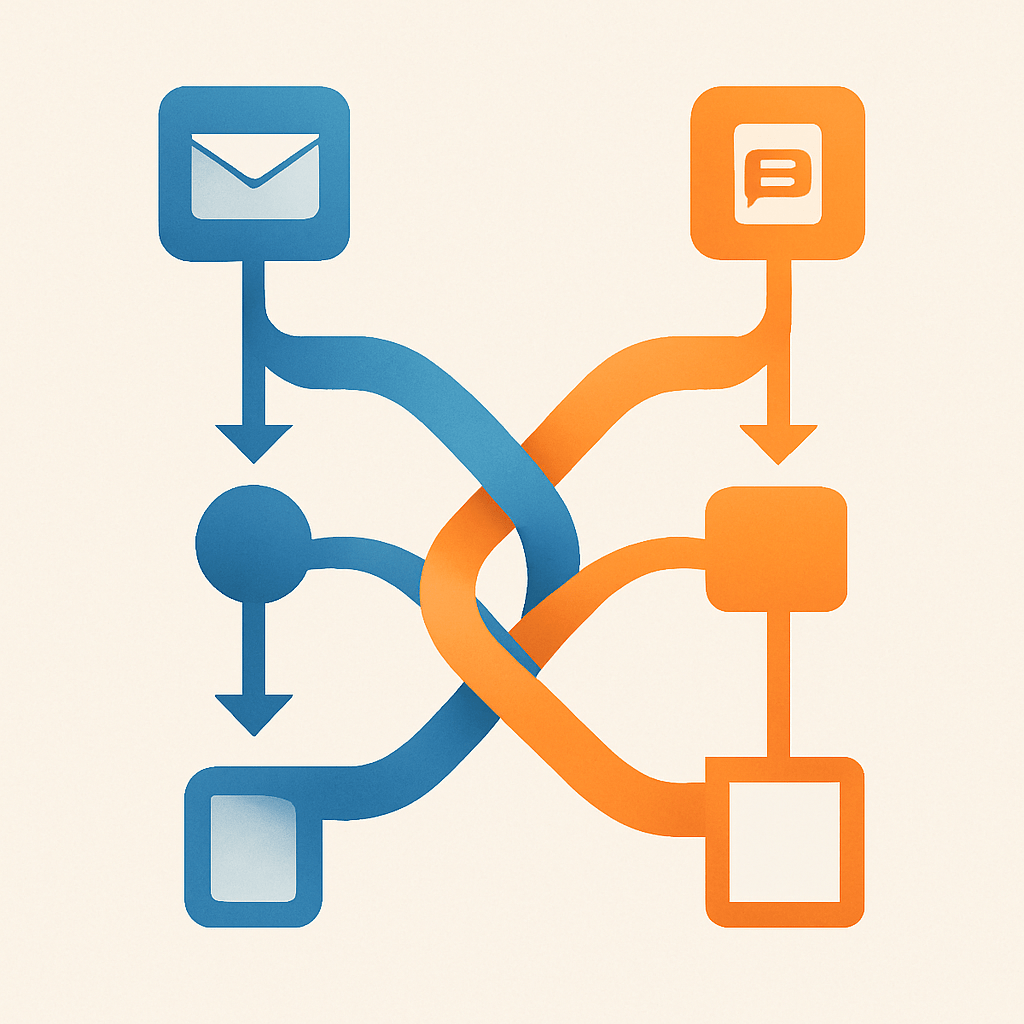
Orchestration means using suppression rules and behavioral branching so no dual subscriber receives redundant messaging within the same campaign window. Even with distinct channel roles, campaign moments (BFCM, product launches, major promos) will inevitably require both channels. The orchestration rules below prevent double-billing subscribers.
What Suppression Rules Actually Work?
- SMS-first for time-sensitive offers under 24 hours. If a flash sale lasts less than a day, send SMS to dual subscribers and suppress them from the email. Send email only to email-only subscribers.
- Email-first for offers longer than 48 hours. Send email to everyone, then send SMS reminders only to dual subscribers who haven’t opened the email within 24 hours.
- Hard cap send frequency. For dual subscribers, cap total marketing messages (email + SMS) at 6–8 per week. Semrush’s cross-channel research found engagement decays sharply beyond 10 messages per week regardless of channel [Semrush Blog, 2023].
- Quiet hours by time zone. Never send SMS before 9 a.m. or after 8 p.m. local time. This is a legal requirement in many U.S. states and materially reduces unsubscribes.
How Should You Design a Handoff Sequence?
For high-value flows like abandoned cart, don’t run email and SMS in parallel—hand off between them based on behavior:
- Hour 1: Email reminder
- Hour 4: If email unopened AND subscriber is on SMS list → send SMS
- Hour 24: Second email (only if no purchase and no SMS click)
- Hour 48: Final email or SMS with incentive (whichever channel had higher engagement historically)
This behavioral branching, supported natively in Klaviyo, Attentive, Postscript, and similar platforms, cuts total messages per subscriber by 40–50% while maintaining or improving conversion rates [Klaviyo Blog, 2024].
Step 5: Segment Aggressively by Channel Preference
Not every customer wants both channels. Some are email loyalists; some are SMS-only. Build segments that respect stated and revealed preferences, then modulate frequency dynamically. Preference-driven segmentation typically reduces total sends 20–30% while improving revenue per subscriber.
What Preference Segments Should You Build?
- Email-only actives: Subscribed to email, engaged in last 60 days, no SMS opt-in
- SMS-only actives: Subscribed to SMS, no email opt-in (rarer, but critical to track)
- Dual-channel highly engaged: Engaged with both channels in last 30 days
- Dual-channel SMS-preferring: Engaged with SMS but not email in last 60 days
- Dual-channel email-preferring: Engaged with email but not SMS in last 60 days
For dual-channel SMS-preferring subscribers, gradually reduce email frequency. For email-preferring, deprioritize SMS. This dynamic frequency management typically reduces total sends 20–30% while improving revenue per subscriber [Mailchimp, 2024].
How Fast Should You Sunset Inactive SMS Subscribers?
Faster than email. SMS carries per-message costs (typically $0.01–$0.03 per SMS, higher for MMS). Unlike email, where sunsetting is mostly about deliverability, SMS sunsetting also protects margin. Sunset SMS subscribers who haven’t clicked in 90 days. This keeps your active file profitable and your engagement rates high. Brands operating with a Retention-First Marketing Budget Framework for Mature DTC Brands should treat SMS list hygiene as a line item, not an afterthought.
Step 6: Measure Incrementality, Not Just Attribution

To prove SMS is additive rather than cannibalistic, you need experiments—not attribution dashboards. The gold standard is a randomized holdout test that compares total revenue per subscriber between a control group (no SMS) and a treatment group (receives SMS) over 30–90 days.
What Is a Holdout Test?
A holdout test randomly withholds SMS from 10–20% of your eligible SMS subscribers for a defined period (30–90 days). Compare total revenue per subscriber (across all channels) between the holdout group and the treatment group. The difference is your true incremental SMS contribution.
Ahrefs and Semrush both cite geo-lift and holdout methodologies as the only reliable way to measure owned-channel incrementality in the era of privacy-driven attribution decay [Ahrefs Blog, 2024]. Run holdout tests at least twice per year, particularly before and after major campaign periods.
Which Metrics Prove Additive Value?
- Incremental revenue per SMS subscriber: Holdout-measured lift, not attributed revenue
- Cross-channel revenue per subscriber: Total email + SMS revenue per dual subscriber vs. single-channel subscribers
- Email engagement of dual subscribers: Are open and click rates for dual subscribers matching or beating email-only subscribers?
- Time-to-first-purchase for new SMS subscribers: Compared to email-only new subscribers
- 90-day LTV by channel mix: Segmented cohorts by acquisition channel and post-acquisition channel adoption
Gartner’s 2024 marketing analytics survey found that only 22% of marketers regularly run holdout tests on owned channels, yet those who do report 34% higher confidence in channel budget allocation [Gartner, 2024]. This is a competitive advantage available to any brand willing to sacrifice a little short-term revenue for measurement rigor.
Step 7: Financial Model — When SMS Pays Off
SMS pays off when incremental revenue per subscriber per month exceeds $0.25–$0.50 net of send fees and platform costs. It looks cheap on a per-message basis but adds up fast, so unit economics matter as much as engagement rates.
A rough unit economics framework:
- Average SMS cost: $0.015 per send
- Average MMS cost: $0.045 per send
- Platform fee: $500–$3,000/month depending on volume
- Break-even revenue per send: typically $0.05–$0.10 to justify inclusion in the mix
Compare this to email’s near-zero marginal cost. A 50,000-subscriber SMS list sent 8 messages per month costs $6,000–$18,000 in send fees alone. For SMS to earn its place in the budget, incremental revenue per subscriber per month should exceed $0.25–$0.50 net of costs. Post-purchase transactional SMS almost always clears this bar; broad promotional SMS often does not.
Step 8: Build a 90-Day Launch or Rebuild Roadmap
A structured 90-day roadmap splits the work into Foundation (Days 1–30), Launch and Instrument (Days 31–60), and Scale and Test (Days 61–90). Each phase has clear exit criteria and guardrail checks so you catch cannibalization before it becomes structural.
Days 1–30: Foundation
- Document email baseline KPIs and set guardrails
- Audit and rewrite opt-in flows for TCPA/GDPR compliance
- Deploy device-aware capture forms with distinct email vs. SMS value propositions
- Define channel roles and content mix
- Set up suppression logic in your ESP/SMS platform
Days 31–60: Launch and Instrument
- Launch transactional and utility SMS flows (order confirmation, shipping, back-in-stock)
- Launch abandoned cart with email-SMS handoff pattern
- Begin measuring email engagement of dual subscribers vs. email-only cohort
- Set up preference-based dynamic frequency segments
Days 61–90: Scale and Test
- Launch promotional SMS campaigns aligned to channel role framework
- Run first 30-day SMS holdout test on 15% of subscribers
- Review email KPIs against guardrails
- Sunset unengaged SMS subscribers (60–90 days no click)
- Publish incrementality report to leadership
Common Mistakes That Destroy the Economics
The most common SMS mistakes are structural, not creative: overlapping sends, identical incentives, missing suppression, and last-click-only measurement. Each one silently converts an additive channel into a cannibalistic one.
- Blasting the same promo to both channels within 2 hours. Guarantees cannibalization and unsubscribes.
- Using identical incentives for email and SMS opt-ins. Trains subscribers that channels are interchangeable.
- Treating SMS as “just another campaign channel.” Ignores the higher unit cost and the intimacy of the medium.
- Ignoring quiet hours and time zones. Damages brand and invites regulatory risk.
- Not sunsetting. Inflates costs and depresses engagement metrics.
- Measuring SMS with last-click attribution only. Overstates value by 30–50% and hides email cannibalization.
The Strategic Takeaway
SMS is not a replacement for email—it’s a complementary channel with a fundamentally different job. The brands that grow SMS profitably treat it as a scarce, high-intimacy medium reserved for urgency, utility, and VIP moments. They acquire subscribers at moments of genuine intent rather than converting existing email subscribers en masse. They measure incrementality through holdouts, not attribution dashboards. And they orchestrate sends so no dual subscriber ever feels spammed.
Get this right and SMS will add 8–15% incremental revenue on top of a healthy email program [BigCommerce Blog, 2024]. Get it wrong and you’ll watch email engagement quietly erode while your reported SMS ROI looks great on paper—until you realize your total owned-channel revenue hasn’t moved at all.
The next quarter is the right time to run your first holdout test. Your finance team, your CFO, and your future budget conversations will thank you.
Frequently Asked Questions
How many SMS messages per week is too many?
For most e-commerce brands, 2–4 promotional SMS per week is the ceiling, and combined email + SMS should stay under 8–10 messages per week for dual subscribers. Semrush’s cross-channel research shows engagement decays sharply beyond that threshold regardless of channel. Transactional SMS (order confirmations, shipping updates) sits outside this cap because customers expect it.
Should I send the same promo on email and SMS?
Rarely, and only for the highest-priority moments like a BFCM opener or a major product launch. For 90% of promotions, use suppression logic so dual subscribers receive the message on their preferred channel only. Sending the same offer twice within a short window is the single most common cause of cannibalization and unsubscribes.
How do I measure incremental SMS revenue accurately?
Run a randomized holdout test: withhold SMS from 10–20% of eligible subscribers for 30–90 days, then compare total revenue per subscriber (across all channels) between the holdout and treatment groups. The gap is your true incremental lift. Last-click attribution alone overstates SMS ROI by 30–50% because it ignores the email touches that primed the conversion.
What’s the minimum SMS list size to make the channel worth it?
Most brands need 5,000–10,000 engaged SMS subscribers before platform fees and operational overhead break even. Below that, focus on transactional SMS (which requires no minimum) and keep building the promotional list through high-intent capture points like post-purchase and back-in-stock alerts.
Is SMS opt-in TCPA-compliant if I got the phone number at checkout?
Not automatically. TCPA requires express written consent specifically for marketing SMS—collecting a phone number for shipping notifications does not authorize promotional texts. You must present a separate, clearly labeled opt-in with disclosure language and store the timestamp, IP, and form copy. Class-action TCPA settlements have exceeded $75 million in recent years, so this is not an area to improvise.
How quickly should I sunset inactive SMS subscribers?
Sunset SMS subscribers who haven’t clicked in 90 days—roughly half the tolerance you’d give an email subscriber. Because SMS carries a per-message cost of $0.01–$0.03, keeping unengaged subscribers on the list directly hurts margin without improving deliverability or engagement rates.
Can SMS actually cannibalize email deliverability?
Indirectly, yes. When dual subscribers begin ignoring email because SMS delivers the same content faster, email open rates drop. Falling open rates signal inbox providers that your sender reputation is weakening, which hurts inbox placement for the subscribers who still engage. Protecting email engagement of dual subscribers is a core reason to enforce the 70/20/10 content split.
References
eMarketer (2024). US SMS Marketing Forecast. https://www.emarketer.com
Klaviyo Blog (2024). Email and SMS Benchmarks Report. https://www.klaviyo.com/blog
Forrester Research (2023). Multi-Touch Attribution and Incrementality. https://www.forrester.com
McKinsey Digital (2023). The Value of Getting Personalization Right in Retail. https://www.mckinsey.com/business-functions/mckinsey-digital
Shopify (2024). Global Ecommerce Report: Mobile Commerce Trends. https://www.shopify.com/blog
Statista (2024). SMS Marketing and Consumer Data Reports. https://www.statista.com
Content Marketing Institute (2023). B2C Content Marketing Benchmarks Report. https://contentmarketinginstitute.com
Semrush Blog (2023). Cross-Channel Marketing Frequency Study. https://www.semrush.com/blog
Mailchimp (2024). Email Marketing Benchmarks and Statistics. https://mailchimp.com/resources
Ahrefs Blog (2024). Measuring Marketing Incrementality in a Privacy-First World. https://ahrefs.com/blog
Gartner (2024). Marketing Analytics and Attribution Survey. https://www.gartner.com
BigCommerce Blog (2024). SMS Marketing for Ecommerce: Strategy and ROI. https://www.bigcommerce.com/blog