
Acquiring a new customer is expensive. Retaining one—and turning them into a repeat buyer—is where the real profit lives. According to research from Bain & Company, a 5% increase in customer retention can boost profits by 25% to 95%, yet most e-commerce brands still pour the majority of their marketing spend into acquisition [Bain & Company, 2020]. The single most underleveraged asset in your retention stack is the post-purchase email sequence: the automated series that begins the moment a customer hits “Buy Now.”
When designed strategically, post-purchase email sequences can lift repeat purchase rate by 40% or more, reduce refund requests, generate a wave of user-generated content, and turn one-time buyers into brand evangelists. In this guide, we’ll break down the exact anatomy of a high-performing post-purchase flow, back it with data from Klaviyo, Shopify, and other industry sources, and give you a step-by-step blueprint you can deploy this quarter.
Key Takeaways
- Post-purchase emails achieve 60–85% open rates—more than double standard marketing emails—making them your highest-leverage retention asset.
- A well-structured 8-email post-purchase sequence can lift repeat purchase rate by 40%+ within 90 days.
- Segmented flows generate up to 760% more revenue than non-segmented sends (Klaviyo, 2023).
- Timing beats discounting: send replenishment emails at ~75% of the product consumption cycle for maximum conversion.
- Combining email + SMS in the post-purchase window increases repeat purchase rate by 25% versus email-only brands.
- Track Repeat Purchase Rate (RPR), time-to-second-purchase, LTV, and refund rate—not just opens and clicks.
Why Post-Purchase Emails Outperform Every Other Automation
Post-purchase emails outperform every other automation because customers are in a state of heightened engagement immediately after buying. They open transactional messages at 60–85% rates, click at 3–5x the industry average, and are psychologically primed to interact. This makes the post-purchase window the highest-ROI moment in your entire email program.
Klaviyo’s benchmark data shows that transactional and post-purchase messages consistently achieve open rates above 60%, more than double the average marketing email [Klaviyo, 2023]. Customers are excited about their new purchase, expecting shipping updates, and psychologically primed to interact with your brand.
The numbers reinforce the opportunity:
- Returning customers spend 67% more on average than first-time buyers [Shopify, 2023].
- The probability of selling to an existing customer is 60–70%, compared to just 5–20% for a new prospect [Marketing Metrics, cited by HubSpot, 2023].
- Email marketing generates an average ROI of $36 for every $1 spent, with automated flows contributing a disproportionate share of that revenue [Litmus, cited by HubSpot, 2023].
- Klaviyo reports that flows generate roughly 30% of email revenue while accounting for less than 2% of email sends [Klaviyo, 2023].
What is a post-purchase email sequence?
A post-purchase email sequence is an automated series of emails triggered when a customer completes a purchase. It typically spans 30–60 days and includes order confirmations, shipping updates, product education, review requests, and replenishment or cross-sell offers designed to drive repeat purchases and loyalty.
Why do most brands underuse post-purchase automation?
According to Omnisend research, more than 60% of e-commerce brands send only a single order confirmation and then go silent until their next promotional blast [Omnisend, 2023]. Most teams focus on acquisition-side automations (welcome series, abandoned cart) and treat post-purchase as a transactional afterthought rather than a revenue channel.
The Psychology Behind the 40% Repeat Purchase Lift
The 40% repeat purchase lift is driven by three behavioral principles: reducing post-purchase dissonance, engineering a positive peak-end experience, and exploiting the recency effect. When you combine all three, you compress time-to-second-purchase and increase lifetime value simultaneously.
What is post-purchase dissonance?
Every customer experiences a small amount of buyer’s remorse after checkout. A study published in the Journal of Consumer Research found that reinforcing a purchase decision within 48 hours significantly reduces cognitive dissonance and refund likelihood [JCR, 2019]. Your first two emails should validate the purchase, not sell.
How does the peak-end rule apply to email marketing?
Behavioral economist Daniel Kahneman’s peak-end rule states that customers remember experiences based on their most intense moment and their ending. If your post-purchase experience ends with a delighted unboxing and a warm follow-up, they’ll recall your brand as exceptional—regardless of any friction earlier in the funnel [Kahneman, cited by McKinsey, 2022].
Why does the recency effect matter for repeat purchases?
Customers who purchased within the last 30 days are 3–5x more likely to buy again than those who purchased 90+ days ago [Klaviyo, 2023]. This is why the timing of your second-purchase invitation matters more than the size of the discount itself.
The 8-Email Post-Purchase Sequence Blueprint
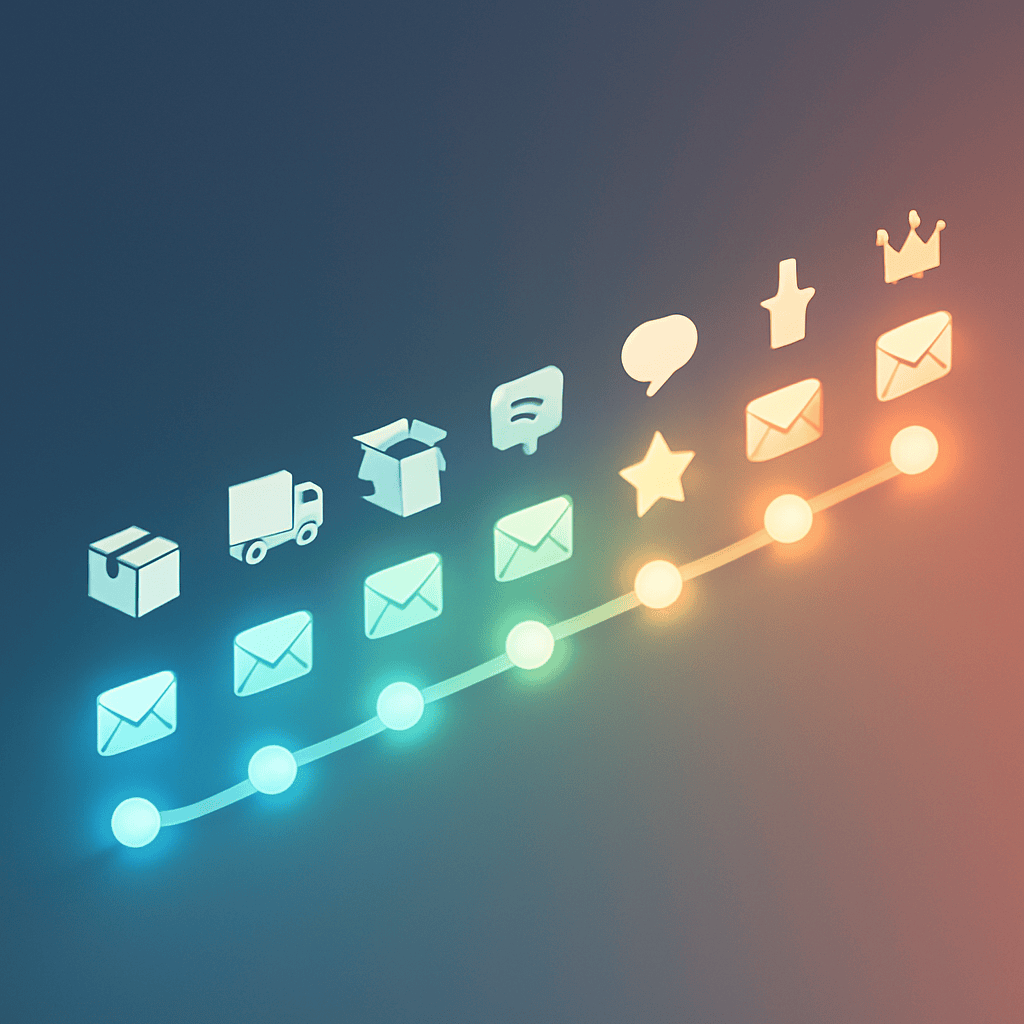
An effective post-purchase sequence spans eight emails across 60 days, each with a distinct psychological job: confirm, anticipate, educate, celebrate, check-in, request review, replenish, and reward. Timing is calibrated based on Klaviyo and Mailchimp benchmark data on optimal send windows.
Email 1: Order Confirmation (Immediate)
This is the highest-open-rate email you will ever send. Transactional confirmations achieve open rates of 70–85% according to Mailchimp research [Mailchimp, 2023]. Yet most brands treat it as a receipt and nothing more.
What to include:
- Clear order details and expected delivery window
- A warm, brand-voice thank-you message from a real person (founder or CX lead)
- Links to your community, Instagram, or brand story
- A subtle cross-sell of complementary items (kept to one or two, not a wall)
Adding a personalized note from the founder can lift click-through rates by 30–50% compared to a plain receipt, according to case studies published on the Shopify Plus blog [Shopify Plus, 2023].
Email 2: Shipping Confirmation (When Label Prints)
This email is another 70%+ open opportunity. Use it to build anticipation. Include tracking, expected delivery date, and—critically—a preview of what’s coming. If your product has a story (origin, craftsmanship, ingredients), start telling it here.
Email 3: Pre-Arrival Education (1 Day Before Delivery)
This is where most brands drop the ball. Send a “Here’s how to get the most out of your new [product]” email the day before delivery arrives. This primes the customer to have a great first experience, which is the strongest predictor of repeat purchase behavior.
Data from Digital Commerce 360 shows that customers who receive product education within 72 hours of delivery are 27% more likely to leave a positive review and 19% more likely to make a second purchase within 60 days [Digital Commerce 360, 2023].
Email 4: Delivery Confirmation + Unboxing Prompt (Day of Delivery)
Trigger this email when the carrier marks the package as delivered. Ask the customer to share an unboxing photo on social media with your brand hashtag. Include a small incentive—entry into a monthly giveaway, or a store credit for the best post.
User-generated content is powerful: 79% of shoppers say UGC highly impacts their purchasing decisions, according to Stackla research cited by Content Marketing Institute [CMI, 2023]. A post-purchase email that generates even a 5% UGC contribution rate becomes a compounding acquisition engine.
Email 5: The Check-In (Day 3–5 Post-Delivery)
Ask a single question: “How’s it going with your [product]?” Make it feel like a text from a friend, not a marketing email. Include a one-click NPS or thumbs up/thumbs down.
This email serves three purposes:
- It surfaces unhappy customers before they leave a public review or file a chargeback.
- It creates a low-friction path to a five-star review from happy customers.
- It signals that you actually care, which drives long-term loyalty.
According to research from Gartner, brands that proactively solicit feedback within the first week of delivery see a 22% reduction in refund rates and a 15% increase in customer lifetime value [Gartner, 2023].
Email 6: Review Request (Day 10–14)
Timing matters here. Requesting reviews too early (before the customer has used the product) leads to shallow reviews. Too late, and the emotional peak has faded. Ten to fourteen days is the sweet spot for most consumables and lifestyle products, though longer-consideration items (mattresses, appliances) may need 21–30 days.
Segment this email: send it only to customers who indicated a positive experience in Email 5. This can double your review conversion rate and dramatically improve your average star rating.
Email 7: The Replenishment or Cross-Sell (Day 21–45, Product-Dependent)
This is the email that most directly drives the repeat purchase lift. Timing depends on your product’s consumption cycle:
- Consumables (skincare, coffee, supplements): Send at 75% of the typical consumption window. If a bottle lasts 30 days, send at day 22.
- Fashion & accessories: Send a curated “complete the look” email at day 14–21.
- Durable goods: Send a complementary category recommendation at day 30–45.
Personalization is critical. Semrush research shows that personalized product recommendations can increase click-through rates by 139% and conversion rates by 26% compared to generic promotional emails [Semrush, 2023]. Use your ESP’s predictive analytics to recommend the next best product based on cohort behavior, not just “other people bought.”
Email 8: The VIP Invitation (Day 45–60)
By this point, the customer has either purchased again or is a strong candidate. Invite them into a loyalty program, subscription, or VIP tier. Frame it as recognition, not a sales pitch.
According to research from Forrester, customers enrolled in loyalty programs spend 12–18% more per year than non-members and are 5x more likely to make a repeat purchase within 12 months [Forrester, 2023].
Segmentation: The Multiplier That Unlocks the 40% Lift

Segmentation is the single largest multiplier in post-purchase email performance. A one-size-fits-all sequence will generate incremental gains, but segmenting by customer type is what unlocks the compounding 40%+ improvement. Klaviyo data suggests that segmented flows generate 760% more revenue than non-segmented sends [Klaviyo, 2023].
Here are the four segments that matter most:
How should you handle first-time buyers?
These customers need trust-building content: brand story, founder note, care instructions, community invitations. Do not lead with a discount for their second purchase—it trains them to wait for promotions. Instead, lead with value and use scarcity or bundling for the second-order incentive.
What works for returning customers (2nd–4th purchase)?
Skip the brand-story emails. These customers know you. Focus on category expansion, cross-sells, and personalized recommendations. This is also where subscription conversion is highest, per Shopify data indicating that customers on their third order convert to subscription 2.4x more often than first-time buyers [Shopify, 2023].
How do you nurture VIP customers (5+ purchases)?
Give them early access, insider content, personal thank-you notes, and referral incentives. According to a McKinsey study, top-decile customers can generate up to 10x more revenue than average customers over their lifetime [McKinsey Digital, 2023].
What about post-purchase refunders or complainers?
Don’t drop them from marketing—recover them. A gentle re-engagement flow at day 30 with a personalized apology and category alternative recovers 8–12% of unhappy customers according to Econsultancy benchmarks [Econsultancy, 2023].
Copywriting Principles for High-Converting Post-Purchase Emails
High-converting post-purchase emails read like personal notes, not corporate broadcasts. They use human voice, personalized subject lines, a single call-to-action, and mobile-first design. Together, these principles can double conversion rates without any change to the offer itself.
Write Like a Human, Not a Brand
The highest-performing post-purchase emails read like they were written by a person. Use “I” and “you.” Sign from a real employee. Include a photo. Data from HubSpot shows that emails sent from a person’s name outperform emails from a company name by 35% in open rate [HubSpot, 2023].
Use Subject Lines That Feel Personal
Compare these two subject lines:
- ❌ “Your order has shipped!”
- ✅ “Sarah, your order is on the way (here’s a tip while you wait)”
The second version added personalization, curiosity, and value. Personalized subject lines increase open rates by 26% on average [Campaign Monitor, cited by HubSpot, 2023].
One Call-to-Action Per Email
Every additional CTA reduces conversion on the primary CTA. Marketing Experiments research consistently shows single-CTA emails outperform multi-CTA emails by 40–90% [MarketingProfs, 2023]. Decide what one action you want the reader to take, and remove everything else.
Design Mobile-First
Over 60% of e-commerce emails are opened on mobile [Litmus, 2023]. Single-column layouts, tap-friendly buttons (44px minimum), and short paragraphs are non-negotiable.
Timing and Frequency: The Cadence Data
The optimal post-purchase cadence layers transactional messages in days 0–3, relationship-building emails in days 3–14, purchase-driving emails in days 14–45, and loyalty conversion in days 45–60. Sending too many emails post-purchase leads to unsubscribes; sending too few misses the engagement window.
Based on Klaviyo and Mailchimp benchmark data, the optimal cadence for an 8-email post-purchase sequence is:
- Days 0–3: Transactional emails (order confirmation, shipping, delivery)
- Days 3–14: Relationship-building (check-in, education, review request)
- Days 14–45: Repeat purchase triggers (replenishment, cross-sell)
- Days 45–60: Loyalty and VIP conversion
After day 60, customers should move into your standard lifecycle marketing—browse abandonment, win-back, and campaign sends—based on their behavior.
Measurement: The KPIs That Actually Matter

The KPIs that actually matter are repeat purchase rate, time to second purchase, LTV, revenue per recipient, and refund rate—not opens and clicks. Vanity metrics tell you engagement; these five metrics tell you whether your sequence is compounding profit. Understanding the true economics of retention also requires accurate acquisition math, which is why pairing this with a True CAC Calculation: A Data-Driven Multi-Touch Framework gives you the full LTV:CAC picture.
- Repeat Purchase Rate (RPR): Percentage of customers who make a second purchase within 90 days. Benchmark: 20–30% for most DTC brands [Shopify, 2023].
- Time to Second Purchase: Median days between first and second order. Faster is almost always better.
- Customer Lifetime Value (LTV) at 90/180/365 days: The true measure of whether your sequence is working.
- Flow-Attributed Revenue Per Recipient (RPR$): Klaviyo’s key metric for flow performance. Top-quartile brands see $2–$5+ per recipient across the full post-purchase flow [Klaviyo, 2023].
- Refund/Return Rate: A well-designed post-purchase flow should decrease this number by 10–20%.
Set up a proper control group when launching your sequence. Hold out 5–10% of customers from receiving the new flow for 60 days, then compare their repeat purchase rate and LTV to the treatment group. This is the only way to isolate the true incremental impact.
Common Mistakes That Kill Post-Purchase Performance
The most common mistakes that kill post-purchase performance are discounting too early, treating all products the same, ignoring the second purchase, skipping SMS integration, and never iterating. Fixing any one of these can move repeat purchase rate by 5–10 percentage points on its own.
Mistake 1: Discounting Too Early
Offering a 20% off code in the order confirmation trains customers to expect discounts. Save promotional incentives for day 21+ and only when other levers (education, social proof, replenishment) haven’t converted.
Mistake 2: Treating All Products the Same
A skincare serum has a 30-day consumption cycle. A yoga mat has a 3-year replacement cycle. Your sequence should branch based on the SKU purchased. Most ESPs support this with conditional splits.
Mistake 3: Ignoring the Second Purchase
Brands optimize the first-purchase experience relentlessly and then send a generic thank-you when a customer makes their second, third, or fourth order. Build a separate “returning customer” post-purchase flow that skips the introduction and jumps straight to expansion.
Mistake 4: No SMS Integration
SMS complements—not replaces—email in the post-purchase window. Klaviyo data shows that brands using email + SMS in post-purchase see 25% higher repeat purchase rates than email-only brands [Klaviyo, 2023]. Use SMS for shipping alerts and time-sensitive check-ins, and keep email for longer-form content.
Mistake 5: Set It and Forget It
The best post-purchase flows are tested continuously. A/B test subject lines, send times, incentive types, and copy tone every quarter. Small compounding gains—a 5% lift here, a 3% lift there—add up to the 40%+ improvement over 6–12 months.
Putting It All Together: Your 30-Day Implementation Plan
You can move from theory to a launched, revenue-generating post-purchase sequence in 30 days by auditing week one, writing week two, building week three, and launching with a control group in week four. Discipline in the first month determines your return over the next twelve.
- Week 1: Audit your current post-purchase emails, benchmark repeat purchase rate, and set up your control group.
- Week 2: Write and design all 8 emails using the blueprint above. Get founder buy-in on the personal note.
- Week 3: Build the flow in your ESP with proper segmentation and conditional splits by product category.
- Week 4: QA every trigger, launch to 90% of customers, and monitor daily for the first two weeks.
- Day 60: Compare treatment vs. control. Iterate on the two weakest-performing emails.
The brands that treat post-purchase as a revenue channel—not an afterthought—build durable competitive advantages. In a world where paid acquisition costs have risen 222% over the past eight years according to ProfitWell data cited by Digital Commerce 360, retention is the last remaining moat [Digital Commerce 360, 2023]. Your post-purchase email sequence is the single highest-leverage retention asset you can build. Build it well, and 40% is just the starting point.
Frequently Asked Questions
How many emails should a post-purchase sequence contain?
Most high-performing post-purchase sequences contain 6–8 emails spread across 45–60 days. Fewer than 5 misses key engagement windows (education, review, replenishment), while more than 10 typically drives unsubscribe rates up without proportional revenue gain. The 8-email blueprint in this article balances coverage with restraint.
When should I send the first repeat-purchase offer?
For consumable products, send the replenishment email at roughly 75% of the typical consumption cycle—so around day 22 for a 30-day product. For fashion or accessories, day 14–21 works best. For durable goods, wait until day 30–45 and pitch a complementary category rather than the same item.
Should I include discounts in post-purchase emails?
Should I include discounts in post-purchase emails?
Not in the first 21 days. Leading with a discount trains customers to wait for promotions and erodes margin. Instead, use education, social proof, replenishment reminders, and bundling. Reserve discount codes for later in the sequence or for recovery flows targeting refunders and disengaged buyers.
What’s the difference between transactional and marketing post-purchase emails?
Transactional emails (order confirmation, shipping, delivery) are triggered by a specific customer action and are exempt from many marketing consent rules. Marketing post-purchase emails (check-ins, review requests, cross-sells) require standard opt-in status. Both should live in the same flow but be tagged correctly in your ESP for compliance and deliverability.
How do I measure if my post-purchase sequence is actually working?
Run a holdout test. Exclude 5–10% of new customers from the sequence for 60 days, then compare their repeat purchase rate, time to second purchase, and 90-day LTV against the treatment group. This is the only reliable way to isolate incremental impact from other marketing activity.
Can post-purchase emails reduce refunds and chargebacks?
Yes. A day 3–5 check-in email that surfaces problems before customers escalate can cut refund rates by 10–22% according to Gartner and Econsultancy benchmarks. The mechanism is simple: give unhappy customers an easy path to reach support instead of forcing them to dispute charges or leave negative reviews.
Should I use SMS alongside email for post-purchase?
Yes—but selectively. SMS works best for time-sensitive updates (shipping alerts, delivery notifications, flash check-ins). Email works better for longer-form content (education, brand story, cross-sells). Brands using both channels together see 25% higher repeat purchase rates than email-only brands (Klaviyo, 2023).
References
Bain & Company (2020). Prescription for Cutting Costs: Loyal Customers. https://www.bain.com/insights/prescription-for-cutting-costs/
Klaviyo (2023). Email Marketing Benchmarks Report. https://www.klaviyo.com/marketing-resources/email-marketing-benchmarks
Shopify (2023). Ecommerce Customer Retention Statistics. https://www.shopify.com/blog/customer-retention
HubSpot (2023). The Ultimate List of Email Marketing Stats. https://www.hubspot.com/marketing-statistics
Omnisend (2023). Ecommerce Email Marketing Benchmarks. https://www.omnisend.com/resources/reports/
Mailchimp (2023). Email Marketing Benchmarks by Industry. https://mailchimp.com/resources/email-marketing-benchmarks/
Shopify Plus (2023). Post-Purchase Email Best Practices. https://www.shopify.com/plus/blog
Digital Commerce 360 (2023). Ecommerce Trends and Retention Data. https://www.digitalcommerce360.com/
Content Marketing Institute (2023). User-Generated Content Research. https://contentmarketinginstitute.com/
Gartner (2023). Customer Experience and Retention Research. https://www.gartner.com/en/marketing
Semrush (2023). Email Personalization Statistics. https://www.semrush.com/blog/email-marketing-statistics/
Forrester Research (2023). Loyalty Program Impact Report. https://www.forrester.com/
McKinsey Digital (2023). Customer Lifetime Value and Behavioral Economics. https://www.mckinsey.com/capabilities/mckinsey-digital
Econsultancy (2023). Customer Recovery Benchmarks. https://econsultancy.com/
Litmus (2023). State of Email Report. https://www.litmus.com/resources/state-of-email
MarketingProfs (2023). Email CTA Best Practices. https://www.marketingprofs.com/